• Skip to primary navigation
  • Skip to main content
  • TTI Home
  • TTI Library Catalog
  • Aviation Research Home
  • Contact Us
Texas A&M Transportation Institute logo
Aviation Research
  • About
  • System Planning and Research
  • Aviation Education
  • Texas Aviation Conference
  • Publications
    • Wingtips
  • News

Wingtips Summer 2021

Tammie Jo Shults Inducted into International Air & Space Hall of Fame

March 7, 2025

Black-and-white photo of a person standing in front of an aircraft. The person is wearing a flight suit with various gear and holding a helmet featuring a star design.

Tammie Jo Shults

Originally published in 2021

Retired Southwest Airlines pilot Tammie Jo Shults has taken her place next to some of the giants of human flight, including Buzz Aldrin, Charles Lindbergh and Howard Hughes, after being inducted Dec. 10, 2020, into the International Air & Space Hall of Fame in San Diego.

Shults, who was a female pioneer as a U.S. Navy pilot, is best known as the captain piloting Southwest Airlines Flight 1380 in April 2018 when a piece of fan blade broke off, tore apart the engine and broke out a window in the Boeing 737 cabin. The engine damage caused dangerous decompression aboard the plane and pulled a passenger, Jennifer Riordan, partially out of the window and caused her death.

Despite the hazardous conditions amid the unstable aircraft, Shults and First Officer Darren Ellisor calmly piloted the Dallas-bound plane to Philadelphia International Airport and no one else on the plane was seriously injured.
Filed Under: Wingtips Summer 2021

Grants Receiving Texas Transportation Commission Approval

March 7, 2025

Originally published in 2021

Commerce Municipal Airport $729,330 Construct parallel taxiway extension
Denver City Airport $4,721,480 Rehabilitate and mark Runway 4-22 and 8-26, hangar access taxiways
Nueces County Airport/Robstown $600,000 Construct new AvGas and Jet A fuel system
Fort Worth Spinks $3,178,030 Rehabilitate and mark Runway 17-35; rehabilitate and mark taxiway A, B, and cross taxiway pavements; replace medium intensity runway light to Runway 17-35; replace taxiway Bravo medium intensity taxiway lights; cross taxiway lights, precision approach path indicators; install medium intensity taxiway light to taxiway K and L.
Cleburne Municipal Airport $6,117,360 Rehabilitate and mark Runway 15-33 and taxiway alpha, and relocate and mark taxiway delta
Draughon-Miller Central Texas Regional Airport $1,661,960 Rehabilitate medium intensity runway lights and signs to Runway 3-21 and Runway 16-34; rehabilitate medium intensity taxiway lights and taxiway signs for A, B, C, D, and F; remark runway numbers Runway 3-21 and 16-34 and remark Runway 3 to non-precision Runway
Mount Pleasant Regional Airport $1,125,030 Expand apron
Majors Field/Greenville $1,100,000 Repair existing drainage structures, construct new drainage headwalls, USACE coordination and drainage improvements
South Texas International Airport at Edinburg $1,037,890 Surface treatment to mark Runway 14-32, apron and taxiways
Scholes International Airport at Galveston $1,174,990 Asphalt surface treatment and mark Runway 14/32 and joint seal north apron
Houston-Southwest Airport $536,570 Crack seal and mark Runway 9-27, rehabilitate and mark taxiway and apron
Aransas County Airport $1,467,250 Rehabilitate Runway 18-36 and Runway 14-32, and surface treatment and mark taxiways
Goldthwaite Municipal Airport $624,800 Install precision path indicator-2 at Runway 1-19; install low intensity runway lights, electrical vault; light wind cone, rotating beacon and tower and runway signage; and flight check
Brooks County Airport $698,000 Replace runway 17-35 medium intensity runway lights with LEDS and airfield sign and replace Precision Approach Path Indicators (PAPIs)
Calhoun County Airport $905,090 Crackseal Runway 14-32; surface treatment and mark Runway 14-32, terminal apron, and parallel taxiway
Aransas County Airport $1,803,560 Rehabilitate Runway 18-36 and Runway 14-32, and surface treatment and mark taxiways
Mid-Valley/Weslaco $954,630 Partially replace Runway 14/32 medium intensity runway light and Runway 32 PAPI
Sulphur Springs Municipal Airport $1,902,180 Expand terminal apron; rehabilitate and mark Runway 1-19; rehabilitate and mark taxiways A, B, C, D, E and terminal apron; and rehabilitate and mark hangar area asphalt apron
Munday Municipal Airport $763,200 Rehabilitate and mark Runway 17-35, rehabilitate turn arounds Runway 17-35 and south apron, replace low intensity runway lights, and replace rotating beacon and tower
Pecos Municipal Airport $5,470,000 Overlay taxiway A, C, E, and P; rehabilitate apron
Mason County Airport $1,100,000 Rehabilitate and mark Runway 18-36, construct Runway 36 turnaround, rehabilitate apron cross taxiways and hanger access taxiway, regrade ditches and runway shoulders and install game fence
Taylor Municipal Airport $1,841,810 Construct terminal apron; relocate beacon, apron access road and electrical vault
Hillsboro Municipal Airport $615,000 Replace medium intensity runway lights Runway 16-34, replace precision approach path indicators-2 Runway 16, install precision approach path indicators-2 Runway 34, and replace windcone
Hall-Miller Municipal Airport/Atlanta $200,000 Automated Weather Observing System at Hall-Miller Municipal Airport

Filed Under: Wingtips Summer 2021

Coulter Airfield on the Rise

March 7, 2025

Originally published in 2021
By Chris Sasser

Texas A&M Transportation Institute 

A small airplane with its front half visible is parked on an asphalt surface in front of a row of industrial buildings

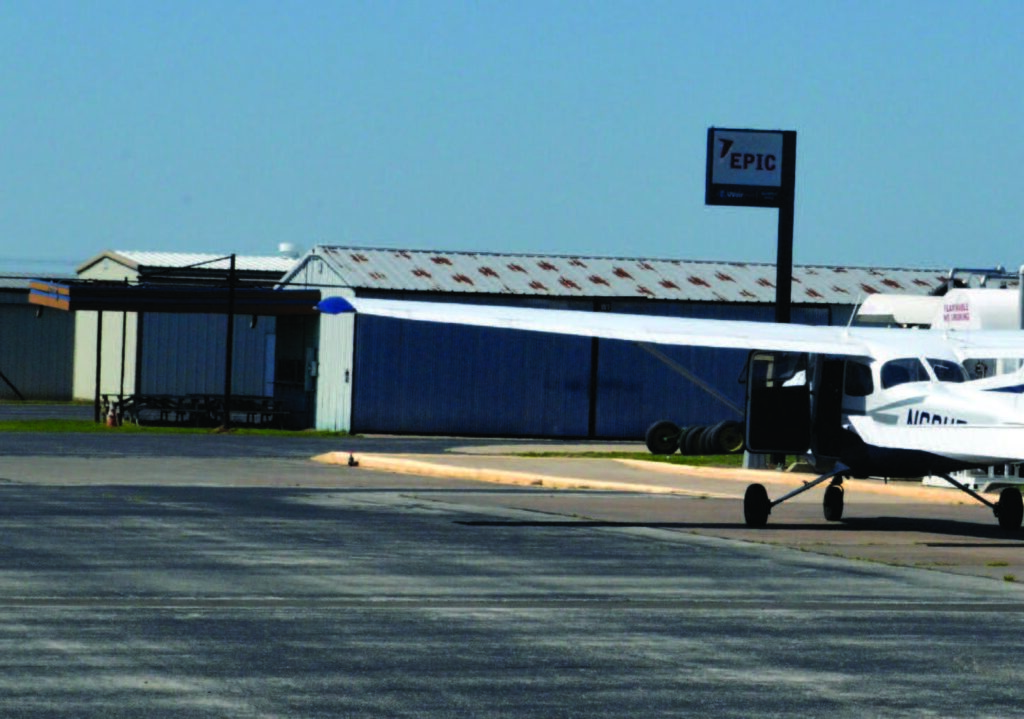
A plane stopping for fuel at Coulter Field Airport.

When Brandon Reid retired from the Air Force, his decision to return to his roots and move his family to Aggieland was a no brainer. Though he had no previous experience as an airport manager, he accepted the Coulter Airfield job in 2017 and went to work learning the ins and outs of the airport management business.

Coulter Airfield is just under 300 acres and was donated by the Coulter family to the city of Bryan in 1938. The airport has held a special place in the community for years, and with the help of previous airport staff and current manager Reid, is starting to take major strides towards becoming an even more attractive destination for not only recreational, but business aviation.

“When I began my job here in 2017, the city had recently approved a bond to build a 10-unit T-hangar that was completed in 2018, and in addition a single box hangar was constructed,” said Reid. “Right after those were completed, the USDA moved their flight operations to our airport, and they now have a hangar and wind tunnel onsite. Another project from the last few years is the upgrade to our fuel system by removing our underground storage tanks and replacing them with two above-ground tanks.

“We’re about to being a new capital improvement project which will focus on runway rehabilitation,” Reid said. “Our goal is to repair and improve our runway, taxiway, and other aircraft movement areas so that they will be functional and operational for the next five to 10 years.”

The project will seek to rehabilitate and mark Runway 15-31 and Taxiway B and add surface treatments and mark the apron and adjoining taxiway.

As the airport has undergone improvements over the past few years, business aviators have taken notice. Several Citation jets and King Airs call Coulter Airfield home, as well as Helibacon, a company that offers helicopter hog hunting.

“There’s only three or four helicopter hog hunting operations in the state and the city of Bryan is very lucky to have this one,” said Reid. “They bring in clients who stay in our hotels, eat in our restaurants, and they expose more individuals to Coulter Airfield than anything else we do.”

The company is currently expanding their hangar to include office space. Reid would also like to construct a new helipad at the airport, for not only Helibacon, but to bring in other helicopter traffic.

Last year the airport began to update their Airport Layout Plan (ALP).

“In that ALP it gives up a 20-to-30-year option to getting to a longer runway up to 5,000 feet,” said Reid. “But they can’t do it on the current headings. The new runway would parallel our eastern boundary. A personal goal within the next five to eight years is to build a parallel taxiway to our runway.”

As for any advice for new airport managers?

“Utilize any and all available resources,” said Reid. “Build relationships with TxDOT Aviation and the Texas Airports Council. They are both great resources!”


Filed Under: Wingtips Summer 2021

Researching Alternate Pavement Inspection

March 7, 2025

Originally published in 2021
By Chris Sasser

Texas A&M Transportation Institute 

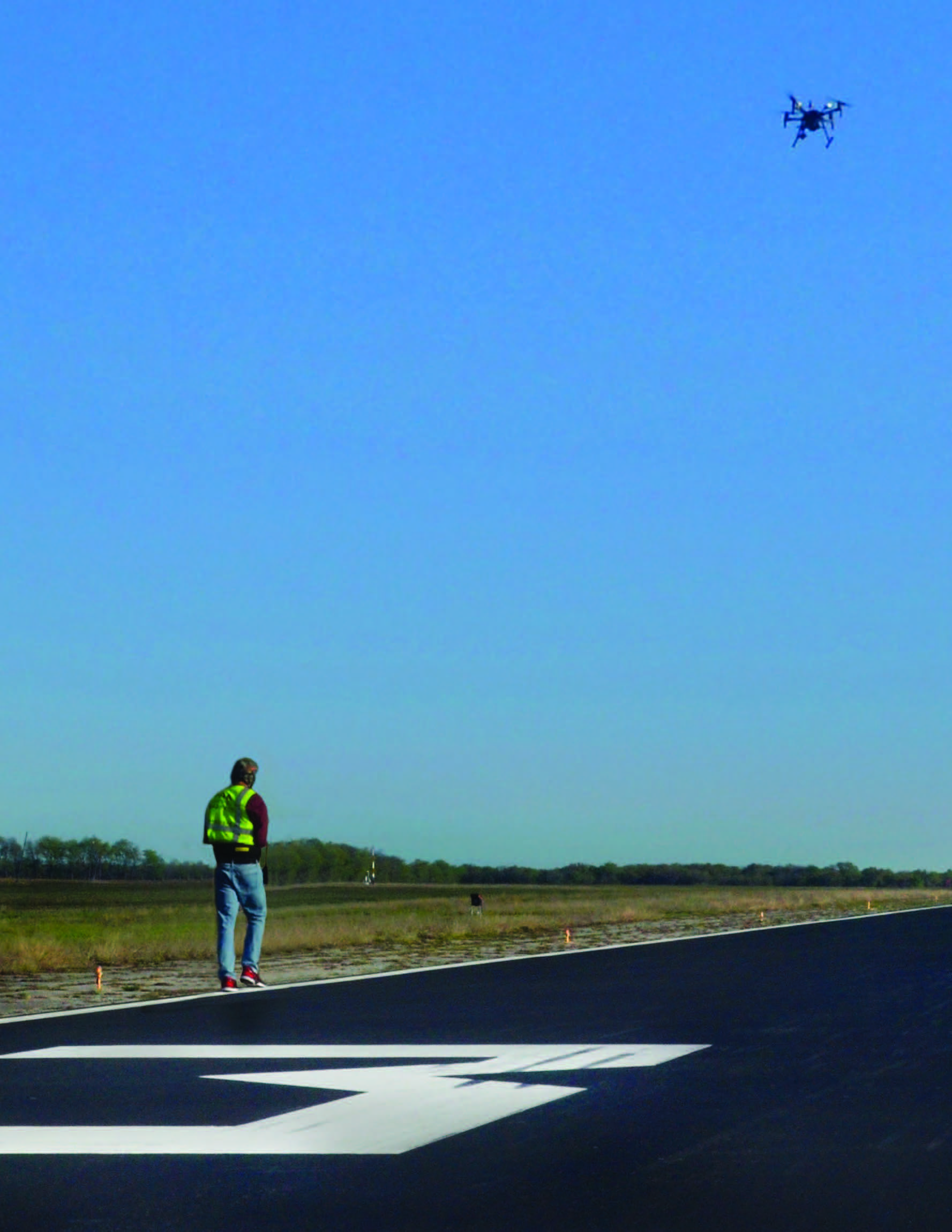
A person wearing a fluorescent safety vest is standing on the edge of an asphalt road, observing a drone flying in the clear blue sky.

TTI Associate Research Scientist Surya Congress follows the drone down the runway during testing at McGregor Executive Airport.

Pavement is the most valuable commodity at an airport. Simply put, without a good landing surface, airplanes cannot safely operate, and that may result in decreased airport traffic.

TxDOT’s Aviation Division (AVN) places a high priority on keeping a database of airport pavement conditions. Under an interagency contract through the Texas A&M Transportation Institute (TTI), airport pavements are inspected every few years and assigned a condition rating that assists planners in programming capital improvement grants.

Recently, researchers at TTI tested an alternate way of assessing pavement conditions at McGregor Executive Airport using a drone and Light Detection and Ranging (LIDAR) equipment.

“Accurate, timely assessments of airfield pavements are of utmost importance to our system airports,” said AVN Director of Planning Jim Halley. “Typically, we have TTI come out and do visual inspections of the pavements, and they do an excellent job. I asked them to test the feasibility of using alternate assessment methods so that we may gather additional data.”

TTI Associate Research Scientist Surya Congress coordinated the drone testing at the airport with TTI pavement specialist Clayton Treybig, who was conducting a visual assessment. The drone hovered 50 feet above the pavement and Congress followed it down the runway conducting several passes. The team also inspected the taxiways and airfield aprons.

Using LIDAR, TTI research staff gathered extensive geometric data on the airport’s pavements, including cross slopes, super elevations, front slope steepness and drainage areas. The technology can also determine the depth of a roadside ditch and its offset related to the nearby pavement structure. All data can be collected at highway speeds. The technology is a single boom-mounted laser device mounted 10 feet in the air. It also uses GPS and an inertial measurement unit plus a video camera.

“Certainly, more is better in terms of gathering information about pavement condition,” noted TTI Senior Research Scientist Jeff Borowiec. “The next steps are to determine the feasibility of using these alternate technologies for widespread use, or in specific cases where a visual inspection may need further analysis.”

“I appreciated everyone who came out to McGregor to conduct and observe the testing,” said AVN Division Director Dan Harmon. “We got more out of it than planned and the analysis and follow up discussion will open up even more possibilities.”

Filed Under: Wingtips Summer 2021

Air Race 1 Prepares for Takeoff in Texas

March 7, 2025

Originally published in 2021

Live air racing will make its return in October 2021 as Air Race 1 heads to San Angelo, Texas, for its first race since the global COVID-19 pandemic began.

The West Texas city will host a series of races on Halloween weekend, Oct. 30-31, 2021, at San Angelo Regional Airport.

The event will be one of the first sporting events open to spectators in the region since the COVID-19 regulations limited live events, provided it will be safe to do so, according to organizers.

Air Race 1 is an air racing series based on the long-running sport known as formula one air racing. Pilots flying single-seater aircraft, purpose-built for racing, compete to be the first to cross the finish line, racing directly against each other at speeds of over 450 kph around a tight three mile circuit, just 50 feet above the ground.

Filed Under: Wingtips Summer 2021

Researchers Develop Airport Economic Impact Estimator Tool

March 7, 2025

Originally published in 2021

Whether providing justifications for grants for airport upgrades or attempting to attract new development, having accurate and timely information about the economic impact of an airport is vital. The Small Airport Economic Estimator enables users to do just that by providing a set of vital economic data at the click of a mouse.

The web tool was developed by researchers at the Texas A&M Transportation Institute under a research project that was sponsored by TxDOT.

“We have assisted TxDOT in preparing a statewide economic impact study in the past,” said Senior Research Scientist Jeff Borowiec, who supervised the project. “But the ability to provide updated or more precise economic impact values to airport sponsors and other stakeholders was needed. For example, there could have been changes in an airport’s activity levels since the last statewide study was performed.”

The research team built the model by using various economic data including visitor spending data from the Texas Governor’s Office, Terminal Area Forecast data from the Federal Aviation Administration, and the latest available data from the recently completed statewide economic impact study of Texas airports.

The web tool takes the model and provides an online interface for users to calculate the economic impact of the airport of their choice. The user has the option to calculate using the default data or provide new inputs based on their knowledge of current conditions.

The web tool takes these inputs and generates summary outputs for three different types of activity:

  • Airport activity—employment or expenses directly related to the functioning of the airport.
  • Visitor activity—the impact of visitor spending on the region.
  • Tenant/business activity—employment or expenses related to any tenants or businesses that are located on the airport.

“Building an estimator tool that can be tailored to each airport provides more precise estimates of that airport’s impact,” said Borowiec. “We also found that economic conditions vary widely across the state, which makes the use of local multipliers and input data key to providing accurate results.”

“The Small Airport Economic Estimator tool provides an easy-to-use resource for airport managers, planners, and local officials,” said TxDOT Aviation Division Director of Planning Jim Halley. “As economic conditions change and the airport develops, it provides up-to-date economic impact numbers that can support grant applications and local funding matches, as well as attract new development. In addition, the Estimator can estimate economic impacts that may be realized if certain improvements are made that increase airport activity.”

The Small Airport Economic Estimator tool may be viewed at: https://txeconomicapproach.org/.

For more information, contact Jeff Borowiec at (979) 317-2283 or [email protected].

Filed Under: Wingtips Summer 2021

Volunteer Honor Students Find Veteran’s Lost Retirement Flag

March 7, 2025

Originally published in 2021
By Mike Geer

Aransas County Airport

On March 2, 2019, “Keep Aransas County Beautiful” and organizer Becky Sanders, put together a last clean-sweep effort of Holiday Beach to rid the community of remaining debris left over from the devastation of Hurricane Harvey which destroyed many of the older homes and damaged all of them. On this day, many volunteers showed up, put on gloves and began working to clean out ditches and areas accessible from the road. Four young National Honor Society students from Rockport/Fulton High School came with lots of energy and enthusiasm. Jolie Hamilton, Kynndrah Warner, Alyna Salazar, and Madeline McCrary along with local volunteer Sandy McCollum proceeded to the area around Hillcrest Road in Holiday Beach to begin the day’s work.

After gathering around 20 bags of trash, they were nearing the end of Hillcrest Road when the girls found a small wooded area with lots of trash in the underbrush. Salazar had just begun removing debris when she noticed a red piece of cloth which she pulled from under a thorny bush. Initially, she thought it was a piece of clothing. She later recalled that she had to tug pretty hard to remove it from the undergrowth and remarked that it was really nasty. As she was just about to put the item in a garbage bag for disposal, she held it up and it unfolded. That’s when she realized it was a Marine Corps flag. McCollum took a look at the tattered flag with all the weeds, roots and dirt but saw no immediate sign of significance. She told the others that it must belong to someone and they should try to find the owner. After their work was over for the day, Sandy took the flag home and laid it on her dock where she proceeded to wash it. She noticed a signature and so she started brushing off the dead weeds. That’s when she saw even more signatures, two, threethen ten!

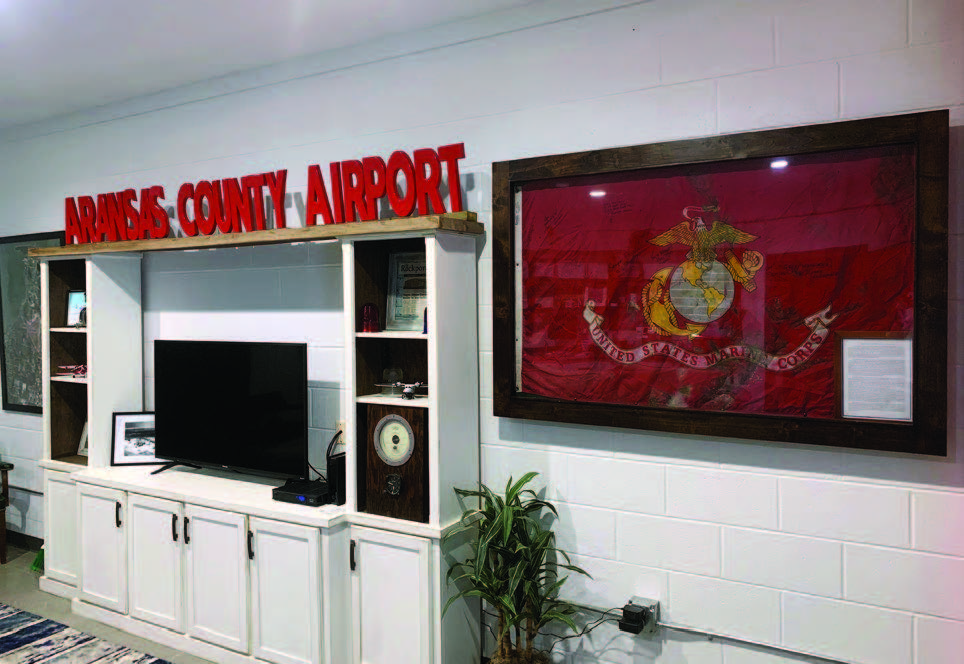
A wall display at Aransas County Airport features a large, red framed United States Marine Corps flag.

Eugene “Gene” Johnson’s United States Marine Corps Flag displayed inside the Aransas County Airport terminal building.

At this point McCollum recognized former Aransas County Commissioner, Betty Stiles’s signature among the others and realized it must have had some importance in the community so she put a post on the “Next Door Holiday Beach” site with a picture of the flag. Current Precinct 4 Commissioner, Wendy Laubach, immediately responded to McCollum giving her Stiles’s contact information. McCollum called Stiles through “Next Door Lamar” and met her at Pop’s Restaurant for breakfast. That’s when Stiles identified it as the flag that had been presented to former United States Marine, Eugene “Gene” Johnson upon his retirement from Aransas County, where he had served as Airport Manager for nearly 35 years. Stiles then contacted current Airport Manager, Mike Geer and made arrangements to bring the flag to the airport. In fact, the flag had been signed by all the airport attendees along with some of the Airport Board Members as well as Geer who recalled that Gene Johnson had hung the flag in a window of his home where he lived in Holiday Beach along with his wife Linda Johnson. Sadly, in February 2016, Gene Johnson passed away at home after a long fight with COPD. Linda Johnson continued to live in their home until Aug. 25, 2017 when Hurricane Harvey destroyed the Johnson Home, scattering her memories over the devastated neighborhood. Linda Johnson had since found permanent residence in Rockport but when she learned that Gene Johnson’s flag had been found, she felt it was important that it be displayed at Aransas County Airport where Gene Johnson had spent so many years leaving his mark on the community.

This United States Marine Corps Flag, the same flag Gene Johnson so proudly displayed in his home, and which was nearly destroyed and lost in a disastrous hurricane, is now on display within the walls of the community hangar which bears his name. Just as Aransas County is fortunate to have benefitted from the services of an individual of Gene Johnson’s character for so many years, we are equally blessed to have citizens such as Hamilton, Warner, Salazar, McCrary, and McCollum who so perfectly exemplify the volunteer spirit of our community.

Filed Under: Wingtips Summer 2021

Texas A&M Transportation Institute

3135 TAMU

College Station, TX 77843-3135

(979) 317-2000

State Resources

The State of Texas

Texas Homeland Security

Texas Veterans Portal

State Expenditure Database

Statewide Search

State Auditor’s Office Hotline

Policies

TAMUS Risk, Fraud & Misconduct Hotline

Site Policies

Open Records Policy

Statutorily Required Reports

TTI Rules

Veterans

Equal Opportunity

Jobs

A member of the Texas A&M University System

© Copyright 2026 Texas A&M Transportation Institute (TTI)